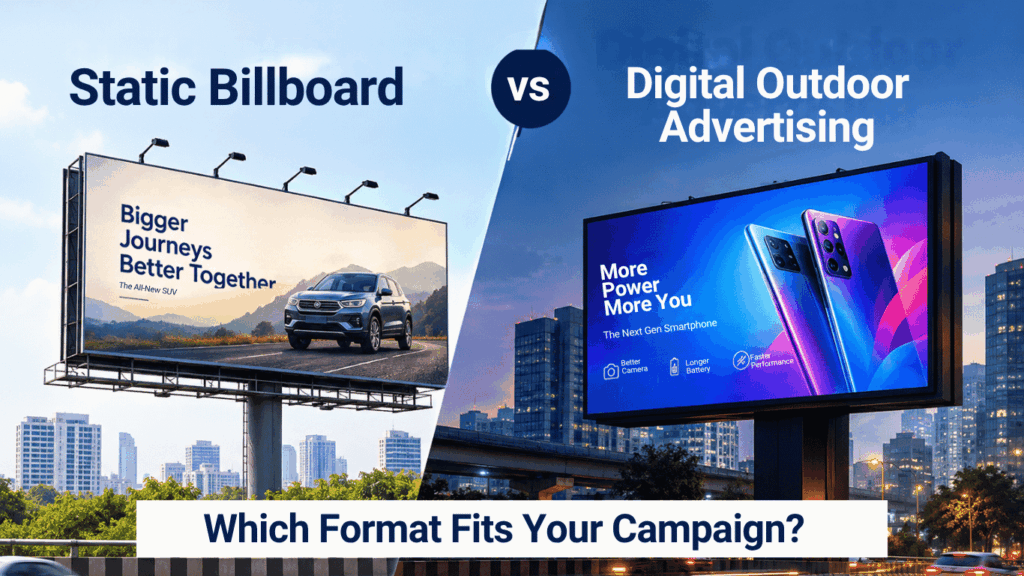
Static billboards suit brands wanting long-term, cost-efficient visibility with a consistent message. Digital outdoor advertising (DOOH) suits brands that need flexibility, real-time updates, and dynamic creative. The right choice depends on your budget, campaign duration, target geography, and how often your message needs to change.
Choosing between static and Digital billboard advertising is one of the most practical decisions a marketing team in India will make. Both formats fall under out-of-home (OOH) advertising, but they behave very differently when it comes to cost, flexibility, and measurability.
Get this decision wrong and you either overspend on technology you don’t need or sacrifice the agility your campaign demands. Get it right and outdoor advertising becomes one of the most cost-efficient channels in your mix.
India’s OOH market is substantial and continues to grow. According to IMARC Group, it was valued at approximately USD 1.4 billion in 2025 and is projected to expand through 2034. Digital formats are attracting an increasing share of that spend, with DOOH growth driven largely by Tier 1 metros where screen infrastructure is most developed. Industry bodies including the Indian Outdoor Advertising Association (IOAA) and global forecasters such as WPP Media have consistently identified OOH—and DOOH specifically—as one of the faster-growing advertising segments in India, though precise share figures vary by source and year.
This guide breaks down how static and Digital billboard advertising differ, when each format performs best, and how Jagmag Advertising—with over 20 years of team experience, PAN India reach across 11,000+ unconventional media touchpoints, and owned LED inventory at railway stations—helps brands navigate this decision.
At a Glance: Static vs Digital Outdoor Advertising
| Decision Factor | Static Billboards | Digital Outdoor Advertising (DOOH) |
| Cost | Lower upfront cost; single production fee; no technology or electricity overheads | Higher cost; pricing varies significantly by market, location, and screen size |
| Flexibility | Fixed creative; changes require manual reprinting and reinstallation | Full flexibility; creative updated remotely within minutes |
| Campaign Duration | Best for 3+ months; longer runs absorb printing costs more efficiently | Better suited to short bursts, time-sensitive promotions, or rotating campaigns |
| Creative Updates | One design per booking period | Real-time updates; multiple creatives can rotate on a single screen |
| Measurement | Limited real-time data; relies on footfall estimates, traffic counts, and post-campaign recall surveys | Granular delivery data; supports programmatic analytics, time-of-day reporting, and audience targeting |
| Geographic Reach | Dominant in Tier 2 and Tier 3 cities where digital screen infrastructure is still limited | Concentrated in Tier 1 metros, where screen density and advertiser demand are highest |
| Audience Targeting | Broad, location-based reach with no dynamic targeting capability | Contextual targeting by time of day, weather, or audience data via programmatic buying |
| Reliability | No dependency on power or software; performs consistently once installed | Dependent on power supply, screen maintenance, and network connectivity |
| Share of Voice | 100% share at each booked location for the full booking period | Shared screen rotation; share of voice determined by slots purchased |
| Best-Fit Use Case | Long-term brand awareness, Tier 2/3 launches, tight budgets, competitive-site dominance | Time-sensitive campaigns, metro-focused activity, multi-brand screen-sharing, interactive formats |
What Is the Difference Between Static and Digital Outdoor Advertising?
Static billboards are traditional printed hoardings. Once installed, the creative stays fixed until the physical vinyl or flex is manually replaced. Digital billboard advertising uses LED or LCD screens to display content managed remotely through software, and it can rotate multiple ads throughout the day.
This single difference—fixed versus flexible content—drives nearly every other distinction between the two formats: cost structure, campaign duration, creative possibilities, and measurement capability.
How Do Static Billboards Work?
A static billboard is a large printed advertisement mounted on a hoarding structure, typically along highways, city intersections, or high-footfall streets. The design is printed once and displayed continuously for the booking period, whether that’s a few weeks or several months.
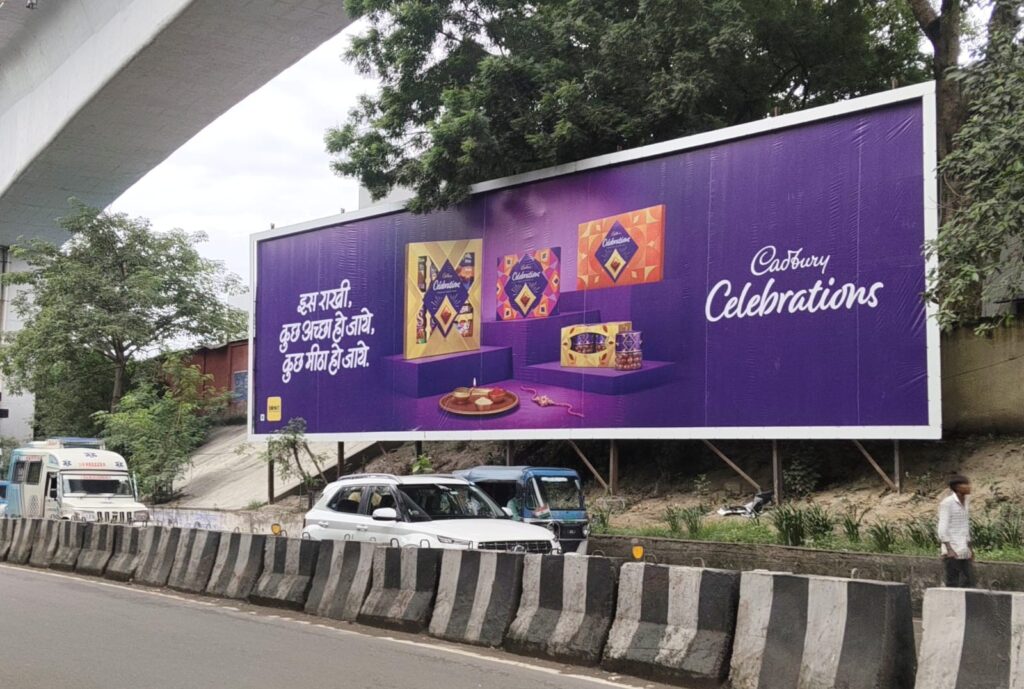
Static formats remain the most widely available outdoor format across India. Their appeal is simplicity: a single upfront design cost, no ongoing technology expenses, and round-the-clock visibility without any dependency on power supply or screen maintenance.
How Does Digital Outdoor Advertising Work?
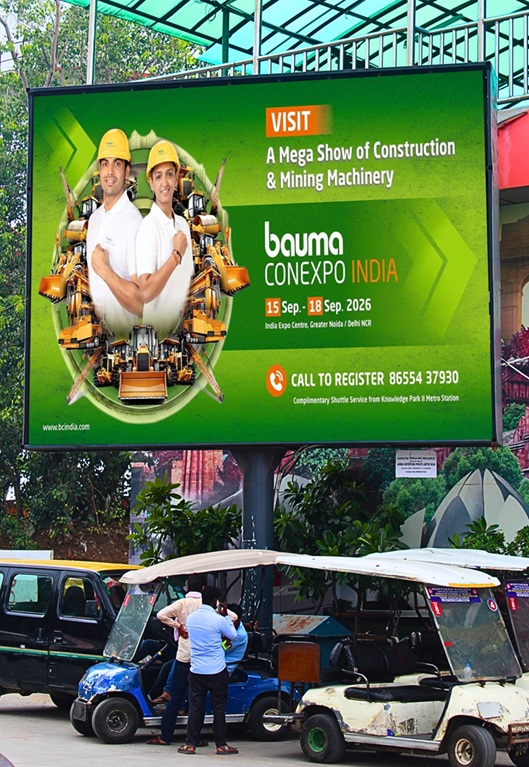
Digital billboard advertising uses networked screens managed through software platforms. Advertisers can update creative remotely, run multiple ads in rotation, and use programmatic buying to serve different messages based on time of day, weather conditions, or audience data.
Digital OOH is growing fastest in high-traffic urban environments—airports, metro corridors, highways, and premium malls in Tier 1 cities—where screen density is highest and the infrastructure to support real-time content delivery is most developed.
Why Does This Choice Matter for Your Campaign?
OOH advertising is widely recognized as a high-recall medium. A 2023 benchmark report published by the OAAA and Solomon Partners found that OOH ads produce significantly higher recall than TV, podcasts, radio, print, and online advertising in the U.S. market. Separate research by Lumen Research and Kinetic found that each additional exposure to an OOH ad drives incremental recall gains—with spontaneous recall rising from around 9% after one exposure to materially higher levels at five or more exposures. India-specific recall benchmarks are less publicly available; brands requiring local data are advised to reference IOAA publications or commission independent studies.
OOH also delivers competitive cost-per-thousand impressions (CPM) relative to most traditional media, and it cannot be skipped or blocked—a structural advantage over digital display formats where ad-skipping remains common.
Choosing the right format determines whether you capture these advantages cost-efficiently or spend on capabilities your campaign doesn’t need.
Key Advantages of Static Billboards
Lower upfront and ongoing cost. Static formats carry a single production cost with no technology or electricity overheads, making them practical for longer campaign durations and tighter budgets.
Best for sustained brand visibility. If your goal is consistent awareness over months, static formats deliver uninterrupted exposure without recurring creative costs.
Wider geographic coverage. Static billboards are the dominant format in Tier 2 and Tier 3 markets, where digital screen infrastructure is still developing. For businesses targeting smaller cities or towns, static is often the only viable outdoor option.
No technology dependency. Once installed, a static billboard performs reliably regardless of power supply, connectivity, or software issues.
Stronger share of voice per location. Because you own the site exclusively for your booking period, there is no rotation dilution. In competitive categories, this can be a meaningful advantage.
Key Advantages of Digital Outdoor Advertising
Real-time flexibility. You can change creative instantly, update pricing, or swap messaging mid-campaign without reprinting anything.
Multiple advertisers, one screen. DOOH screens rotate ads from several brands, which splits costs and makes premium locations accessible to advertisers who couldn’t otherwise afford exclusive static placements.
Data-driven targeting. Programmatic DOOH platforms serve contextually relevant ads—weather-triggered creative, time-of-day targeting, or audience-matched content—which can improve relevance and measurability.
Interactive and immersive formats. Digital screens support video, animation, and in some cases interactive elements, enabling brand experiences that static formats simply cannot replicate.
Real-time performance reporting. Programmatic DOOH platforms log impressions served, track delivery by time of day, and can integrate with mobile audience data to estimate reach and frequency—making mid-campaign optimization genuinely feasible.
Limitations of Each Format
Understanding where each format underperforms is just as important as knowing where it excels.
Where Static Billboards Fall Short
- No mid-campaign adjustments. If your offer changes, a product launches early, or a message needs updating, you’re stuck with the original creative until the booking ends or you pay for a reprint and reinstallation.
- Limited measurement. You will not know how a static campaign performed until after it ends. Footfall estimates and recall surveys provide useful directional data but are lagged and inexact.
- No targeting by audience or context. Every commuter who passes sees the same message regardless of relevance. There is no mechanism to serve different content to different audiences or at different times of day.
- Creative fatigue risk. For very long bookings, the same creative seen repeatedly by the same audience can lose impact over time.
Where Digital Outdoor Advertising Falls Short
- Higher cost and complexity. DOOH placements carry a higher unit cost than most static alternatives, and running multiple creative variants adds production expense. Campaigns with small budgets may find DOOH pricing prohibitive.
- Technology dependency. Digital screens require reliable power supply, network connectivity, and regular maintenance. Downtime, screen failures, or software issues can interrupt delivery without immediate warning.
- Diluted share of voice. On a shared rotation screen, your brand is one of several advertisers. If competitive dominance at a specific site is a priority, digital formats often underdeliver compared to a static exclusive booking.
- Limited reach outside Tier 1 cities. Digital screen inventory remains thin in Tier 2 and Tier 3 markets. For campaigns targeting smaller cities or semi-urban areas, DOOH may not be a viable option at all.
- Measurement complexity. While DOOH offers more data than static formats, the methodology for translating impressions into business outcomes varies by platform and requires informed interpretation.
Decision Matrix: Which Format Should You Choose?
Use this framework to match format to campaign objective:
| Your Situation | Recommended Format |
| Campaign runs 3+ months with a single, stable message | Static |
| Campaign runs under 6 weeks with time-sensitive creative | Digital (DOOH) |
| Target market is Tier 2 or Tier 3 city | Static |
| Target market is a Tier 1 metro with strong digital inventory | Digital (DOOH) |
| Budget is tight and cost predictability is essential | Static |
| Budget supports higher unit cost in exchange for flexibility | Digital (DOOH) |
| Creative needs to update mid-campaign (pricing, offers, dates) | Digital (DOOH) |
| Creative is fixed and benefits from repeated exposure | Static |
| Competitive dominance at a specific site matters | Static |
| Broad reach across many locations matters more than site dominance | Digital (DOOH) |
| Post-campaign recall data is sufficient for reporting | Static |
| Mid-campaign delivery data and optimization are required | Digital (DOOH) |
| Campaign spans both metro and non-metro markets | Hybrid |
| Time-sensitive launch in metros + sustained visibility in smaller cities | Hybrid |
How to Decide Between Static and Digital for Your Campaign
1. Define Your Campaign Duration
Static billboards become more cost-efficient the longer they run, since the upfront print and installation cost is absorbed over a longer display period. Campaigns of three months or more typically favor static formats on a cost-per-week basis.
For short-burst campaigns of two to four weeks—tied to a product launch, seasonal offer, or promotional window—digital formats can justify their higher unit cost through flexibility and the ability to optimize mid-flight.
2. Assess Your Target Location
If your audience is in a Tier 1 city with strong DOOH inventory—Mumbai, Delhi NCR, Bengaluru, Hyderabad—digital outdoor advertising is a viable and often preferable option. If your campaign targets Tier 2 or Tier 3 markets, static billboards are typically the practical default, since digital screen availability remains limited in these areas.
3. Consider Creative Flexibility
If your messaging will stay consistent throughout the campaign, static is efficient and reliable. If you need to update pricing, rotate multiple creative variants, or align messaging with real-world events or dates, digital is the only format that allows this without additional cost and delay.
4. Calculate Your Budget Realistically
DOOH placements vary widely in cost depending on location, screen size, and booking duration. Factor in not just media cost but also the production of multiple creative assets if you plan to rotate content. Static formats carry a predictable upfront cost that is easier to model across a defined booking period.
5. Factor in Your Measurement Requirements
Static campaigns are measured through proxy methods: footfall estimates, traffic count data, post-campaign brand recall surveys, and sales uplift analysis in the catchment area. These are meaningful but lagged—you learn results after the campaign, not during.
DOOH campaigns support near-real-time reporting: impressions served, time-of-day delivery, creative rotation performance, and in some cases mobile audience data integration. If mid-campaign optimization or live delivery reporting is required, digital is the only format that supports this.
6. Evaluate Share of Voice Against Competitors
In static OOH, booking a site means owning it exclusively for the full period. A brand holding key highway or arterial sites in a city has strong visual dominance with no rotation dilution.
In digital OOH, share of voice is proportional to the rotation slots purchased. A brand buying 25% of a screen’s rotation shares visibility with up to three other advertisers. In competitive categories—retail, FMCG, banking, telecom—static formats often deliver a stronger site-level share of voice. Digital OOH can deliver broader network reach for a comparable budget, even if per-site dominance is lower.
7. Get Local Expert Input
Site-level footfall data, current pricing, and competitive activity at key locations all affect outcomes in ways that are difficult to assess without direct market knowledge. An experienced outdoor advertising partner can run a pre-campaign site audit to identify where competitors are active and where your budget will have the most impact.
Jagmag Advertising: How Format Decisions Are Made in Practice
Jagmag Advertising provides OOH planning solutions across static hoardings, large-format transit media across Indian Railways, exclusive LED media at railway stations, and more than 11,000 unconventional media touchpoints across India. This breadth allows format recommendations to be based on the media environment, campaign objectives, and audience reach—not a default preference for one format over another.
Case Study 1: FMCG Brand Launch Across Tier 2 Cities (Static)
When a regional FMCG brand needed to support a new product launch across Tier 2 cities in North India, the format decision was straightforward. Digital OOH inventory in these markets is limited, and the brand needed sustained, months-long visibility at a cost structure appropriate for a launch-stage product budget.
Jagmag identified high-footfall hoarding sites along key arterial roads in the target cities, negotiated a multi-month booking to reduce per-week cost, and locked in placements ahead of the launch window. The campaign delivered consistent brand presence throughout the critical awareness phase—without the technology dependency or screen-sharing trade-offs that a DOOH buy in these markets would have introduced.
Why static worked here: Long campaign duration, Tier 2 geography with limited digital inventory, single stable message, cost-sensitive budget.
Case Study 2: Fintech Brand Promotional Window in Mumbai (Digital)
When a fintech client needed to promote a limited-time offer across Mumbai, the brief came with a specific constraint: the offer terms and interest rate needed to update at least twice during the campaign window as market conditions shifted. A static billboard was ruled out immediately—mid-campaign reprints and reinstallation would have been both costly and too slow.
Jagmag secured programmatic DOOH placements across high-traffic screens in key Mumbai corridors, allowing the client to push creative updates remotely within hours of each rate change. The campaign ran within a compressed timeline and delivered measurable reach without incurring the reinstallation costs a static buy would have required.
Why DOOH worked here: Short campaign window, Tier 1 market with strong digital inventory, creative that needed to update mid-campaign, measurability required.
Case Study 3: Government Campaign Amplification (Owned LED Media)
Jagmag’s owned large-format LED inventory—including exclusive railway station screens—has been used to amplify government campaigns targeting diverse urban audiences at high-footfall locations. Railway stations in India serve millions of daily commuters across income groups and geographies, making them a distinctive medium for campaigns that need genuine mass reach in a single placement. The combination of scale, dwell time, and contextual relevance in transit environments produces strong message recall without the audience fragmentation of digital display.
Why Jagmag’s rail LED inventory works here: High and consistent footfall, extended audience dwell time, broad demographic reach, and owned media that avoids third-party screen availability constraints.
The Hybrid Approach
Many campaigns benefit from combining both formats. Jagmag’s planning approach for hybrid briefs is to assign each format a distinct job: static for sustained baseline awareness in smaller markets, and DOOH for tactical flexibility in metro zones where digital inventory is available and short-term agility is required.
A recent FMCG campaign illustrated this well. Static hoardings were locked in across Tier 2 corridors ahead of launch to build awareness over a sustained period. Parallel DOOH placements in metro markets enabled the brand to push promotional creative during key retail weekends—creative that updated remotely without touching the static sites. The blended approach delivered both sustained coverage and tactical agility at a combined cost that neither format could have achieved independently.
Choosing the Right Outdoor Advertising Partner
The static-versus-digital decision is simpler when you’re working with a partner who has direct access to inventory across both formats, site-level footfall data, and a clear view of competitive activity at key locations.
Jagmag Advertising works across static hoardings, digital screens, transit media, railway LED, and unconventional touchpoints. Format recommendations are driven by campaign objective, geography, budget, and measurement requirements—not inventory preference. If you’re unsure which format fits your next campaign, a pre-campaign consultation with site-level data can typically clarify the right path quickly.
Limitations of This Guide
The statistics and market figures referenced in this article reflect publicly available sources as of mid-2025. India’s OOH market is evolving quickly, and precise figures for market size, DOOH share, and pricing vary across reports and methodologies. Where exact figures could not be verified from a primary public source, directional language has been used instead. Brands making significant media investment decisions are advised to obtain current rate cards directly from media owners and reference the latest IOAA or GroupM India publications for up-to-date market data.
Frequently Asked Questions
Is a static billboard or digital outdoor advertising more cost-effective for a short-term campaign?
For campaigns running two to four weeks, digital outdoor advertising is usually more cost-efficient despite its higher unit cost. Static billboards require upfront printing and installation fees that are difficult to justify for short bookings, since those fixed costs are spread over a shorter display period. DOOH placements carry no print or installation expenses—you pay for screen time only, and creative can be updated remotely at no additional cost. That said, if your short-term campaign targets a Tier 2 or Tier 3 market where digital screen inventory is limited, static may be your only practical option regardless of duration.
Can static and digital outdoor advertising be used together in the same campaign?
Yes, and for many brands a blended approach delivers stronger results than either format alone. Static billboards provide sustained, cost-efficient visibility over longer periods and across wider geographies. Digital OOH layers in flexibility for time-sensitive messaging, creative rotation, and metro-focused activity. The key is to give each format a distinct role—static for baseline awareness in smaller markets, DOOH for tactical bursts where inventory and flexibility are available. Campaigns where both formats duplicate the same objective tend to underperform relative to campaigns where each format has a defined job.
How does voice work differently in static versus digital outdoor advertising?
In static OOH, booking a site means exclusive ownership for the full booking period. You receive 100% of impressions at that location with no rotation dilution. In digital OOH, share of voice is proportional to the rotation slots you purchase. A brand buying 25% of a screen’s rotation shares visibility with up to three other advertisers. For competitive categories like retail, FMCG, or banking, static sites often deliver a stronger share of voice per location. Digital OOH, however, enables broader network reach across many screens for a comparable budget—trading site-level dominance for geographic spread.
What are the main risks of choosing digital OOH over static?
The main risks are cost overrun, technology dependency, and diluted share of voice. DOOH unit costs are higher than most static alternatives, and producing multiple creative variants adds expense. Shared-screen rotation means your brand is always competing for attention at any given moment. Digital screens also depend on power supply, connectivity, and software—factors that can cause unplanned downtime. In Tier 2 and Tier 3 markets, digital screen availability may be too limited to build meaningful reach at all.
When should a brand shift from static to digital outdoor advertising as it scales?
The trigger is usually a combination of three factors: campaigns becoming shorter and more frequent, target markets shifting toward Tier 1 metros, and stakeholders requiring mid-campaign delivery data rather than post-campaign recall surveys. If your campaigns now run on monthly or quarterly cycles with rotating creative, DOOH flexibility will consistently outperform static on cost-per-outcome. If campaigns still run for three or more months, target smaller markets, and carry a single stable message, static likely remains the more cost-efficient choice regardless of brand size. Most scaling brands don’t switch entirely—they add digital OOH as a tactical metro layer while retaining static placements for sustained coverage in smaller markets.
Does Jagmag Advertising work with both static and digital OOH formats?
Yes. Jagmag Advertising works across static hoardings, large-format transit media on Indian Railways, exclusive LED screens at railway stations, and over 11,000 unconventional media touchpoints across India. The team’s approach is format-neutral—the recommendation is driven by what the campaign objective, geography, and budget actually require. For brands unsure which format fits their next campaign, Jagmag offers pre-campaign planning consultations based on site-level availability, footfall data, and competitive context.