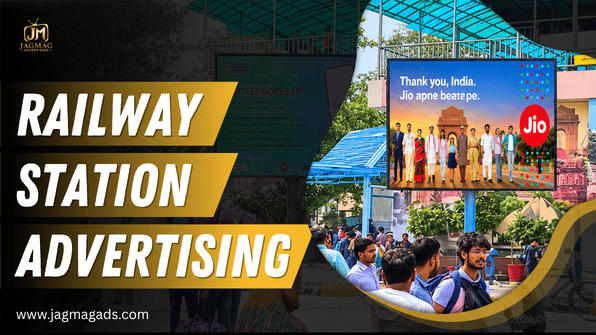
Railway station advertising in India places brand messages in authorized advertising spaces inside railway stations, including concourses, platforms, entrances, foot overbridges and waiting areas. It is a form of out-of-home (OOH) marketing that keeps brands visible to travelers throughout their time at the station, whether they are waiting for a train, moving between platforms or arriving at a destination.
India’s railway network is one of the largest in the world. According to the Ministry of Railways’ Statistical Summary Sheet, Indian Railways recorded 690.5 crore originating passengers in FY 2023–24 and 729.3 crore in FY 2024–25. This growing passenger volume makes railway stations some of the country’s most consistently occupied public spaces, offering brands valuable opportunities to connect with large audiences.
Not all of that traffic is equally reachable. Passenger density varies significantly between major city terminals, district junction stations and smaller local stations. That is why station selection, placement and format matter more than the scale of the network.
At Jagmagads, we work across outdoor (OOH) and digital out-of-home (DOOH) advertising. We hold LED screen advertising inventory at two well-connected long-distance rail terminals in Delhi: New Delhi Railway Station and Hazrat Nizamuddin Railway Station. This guide draws on that first-hand experience alongside published industry benchmarks.
It covers:
- What railway station advertising is and how it works in India
- The main formats and how to compare them
- What railway advertising costs, with a clearly labeled third-party pricing benchmark
- How LED screen advertising works, with verified details from Jagmagads’ own screens
- What to check before booking and how to plan a campaign
What Is Railway Station Advertising?
Railway station advertising is a form of out-of-home (OOH) marketing where businesses display promotional messages in authorized advertising spaces within railway station premises.
These spaces include entrances, concourses, waiting halls, platforms, foot overbridges and other designated locations.
Station advertising sits within the passenger’s physical environment. It does not rely on a device, an internet connection or a user action to appear. Its visibility, however, depends entirely on placement, passenger movement patterns and the quality of the creative. An ad in a well-positioned waiting area gets far more attention than one on a side wall along a fast-moving walkway.
Station inventory falls into two broad groups:
- Static media: Printed hoardings, backlit panels, pillar wraps and wall branding. The same creative remains in place for the full booking period.
- Digital media (DOOH): LED screens that play video, animation or rotating creatives in a scheduled loop, typically shared with other advertisers.
Advertising rights at stations are managed through Indian Railways, its concessionaires or licensed media operators. Advertisers must book through an authorized channel and obtain creative approval before a campaign goes live. Train advertising regulations are enforced by regional railway divisions, and brands must partner with licensed vendors to ensure compliance.
Why Is Railway Station Advertising Effective in India?
Railway station advertising works in India because it combines consistent physical presence, extended passenger dwell time, regional language targeting and visibility that doesn’t depend on device usage or internet access.
Its effectiveness is not uniform, though. It depends heavily on the station, the placement within that station and the quality of the creative.
1. Access to a Wide Range of Passenger Profiles
A single major terminal serves students, office commuters, business travelers, families and tourists, sometimes within the same hour. Mass-market brands benefit from that range. More targeted brands need to choose stations and placements where the right audience concentrates, at the right time of day.
2. Extended Viewing Time During Dwell Periods
Passengers arrive before departure, wait for platform announcements, queue at ticket counters and manage delays. Ads placed near waiting areas and concourses remain in view for longer than roadside hoardings seen at speed. That advantage is real, but it applies only where passengers actually stop. Screens and panels on busy through-walkways get glances, not sustained attention.
3. Regional Language Targeting
You can communicate with passengers in their preferred language. A campaign at a terminal in Jaipur may lead with Hindi; one in Chennai may use Tamil. At Delhi terminals, where many long-distance services cross language regions, bilingual Hindi-English creatives are a practical choice.
4. Visibility Independent of Digital Platforms
Station advertising does not require the passenger to open an app, visit a website or see an algorithm-driven placement. It reaches people during a period when they are in a physical environment and attentive to it. Combining station advertising with digital campaigns can also reinforce brand recall across channels.
What Are the Most Popular Railway Station Advertising Formats?
The main railway station advertising formats are: platform hoardings, digital LED screens, entry and exit gate advertising, pillar wraps, wall branding, train wraps and full station branding.
Here is how the main formats compare:
| Format | Best For | Key Consideration |
| Platform hoardings and backlit panels | Sustained brand awareness | Most effective where passengers wait, not on through-traffic platforms |
| Digital LED screens | Product launches, offers and motion-led campaigns | Shared loop; how often your ad plays depends on the number of advertisers |
| Entry and exit gate advertising | Local retail, hotels, cab services, food | Short viewing time; message must be very simple |
| Pillar wraps and wall branding | Repetition and brand recognition along passenger routes | Subject to operator approval and site dimensions |
| Train wraps (coach exterior and interior) | Route-specific reach; high-frequency visibility | Different regulatory framework from station advertising; managed separately |
| Full station branding | Large national campaigns seeking complete station presence | Highest cost; requires creative coordination across multiple formats |
Platform Hoardings and Display Panels
Large panels in authorized platform areas are among the most common formats. They come in non-lit, front-lit and backlit versions. Backlit panels perform better in covered or poorly lit platform areas and remain readable during evening and night services.
Digital LED Advertising Screens
LED screens display animated visuals, short videos and rotating creatives. They suit brands that update offers regularly, want to run several messages within one campaign or rely on motion to communicate a product benefit. The format is covered in detail in the LED section below.
Entry and Exit Gate Advertising
Placements near entrances and exits reach passengers as they arrive or leave. People at these points are usually moving with purpose, so the message needs to be immediate and simple. These placements suit hotels, cab services, food outlets and local retailers with a nearby call to action.
Pillar Wraps and Wall Branding
Pillars and wall surfaces can be branded with printed wraps, subject to operator approval. Repeating the same visual across several pillars along a walkway builds frequency within a single passenger journey.
Train Wraps
Train advertising places promotional messages on the exterior or interior of coaches. It operates under a different regulatory framework from station advertising and reaches passengers along a specific route rather than at a single location. Both are forms of transit advertising, but their audiences, booking processes and commercial arrangements differ.
Full Station Branding
Full or partial station branding coordinates approved panels, screens, pillar wraps and other formats into a single coherent presence. It suits large campaigns where the objective is to create consistent brand visibility across every passenger touchpoint at a station. It requires a larger budget, longer lead times and careful creative coordination.
Railway Station LED Advertising: How It Works
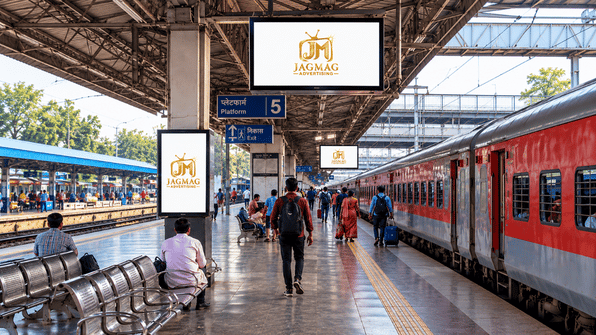
Railway station LED advertising displays brand videos or animated creatives on digital screens installed within station premises. Ads play in a scheduled loop, with each advertiser booking a fixed number of slots per loop over an agreed campaign period.
Understanding the mechanics helps you evaluate a screen’s actual value before committing a budget.
- Slots and loops: The screen runs a playlist of ads. Each ad plays for a set duration, then the playlist repeats. The number of times your ad plays per hour depends on your slot duration and the number of advertisers sharing the loop. Fewer co-advertisers means more plays per hour.
- Ad slot duration: Slot durations vary by operator and screen. Confirm the exact duration for your placement before booking, as this affects how much time you have to communicate your message.
- Operating hours: The Jagmagads LED screens at New Delhi Railway Station and Hazrat Nizamuddin Railway Station operate 24 hours a day, seven days a week. This means your creativity is on display continuously, including late-night and early-morning departures and arrivals.
- Creative delivery: You supply video or image files in the operator’s specified resolution, format and maximum duration. Files are loaded into the playlist after content approval.
- Silent viewing: Railway stations are noisy environments. Most LED screens play without audio. Your creativity must communicate entirely through visuals and on-screen text.
- Proof of display: Ask for photographic or video evidence of your ad playing on the screen, along with scheduling records where available.
The main advantage over static media is creative flexibility. You can update messaging mid-campaign, run time-sensitive offers and test more than one creative version without printing and remounting.
Real-World Experience: LED Screen Advertising at New Delhi & Hazrat Nizamuddin Railway Stations
Jagmagads holds LED screen advertising inventory at two significant long-distance rail terminals in Delhi: New Delhi Railway Station and Hazrat Nizamuddin Railway Station. The insights below reflect our direct knowledge of these screens and their operating environments.
New Delhi Railway Station: Screen Details
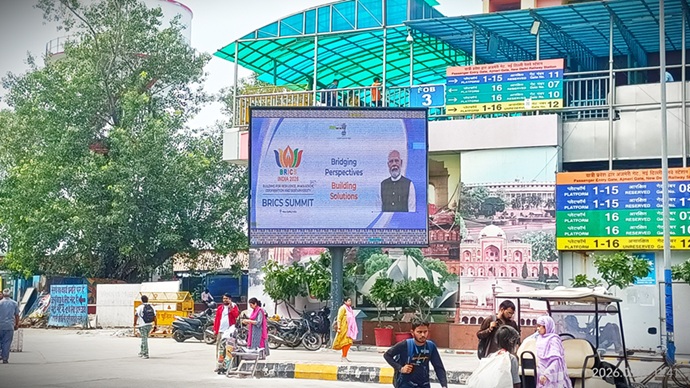
Our LED screen at New Delhi Railway Station measures 16.5 feet wide by 13 feet tall. It operates 24 hours a day, making it available to passengers arriving and departing at all hours, including late-night and early-morning services that are common at this terminal.
New Delhi Railway Station sits in central Delhi and serves a large volume of long-distance train services across multiple directions. The station is connected to the Delhi Metro, which adds a secondary footfall of commuters passing through the station area.
From a planning perspective, the screen’s location, orientation and viewing angle make it most effective for campaigns that target passengers during platform waiting periods or while moving through key transit areas. High-contrast creatives with bold headlines perform best, particularly during daylight hours when ambient light is a factor.
Hazrat Nizamuddin Railway Station: Screen Details
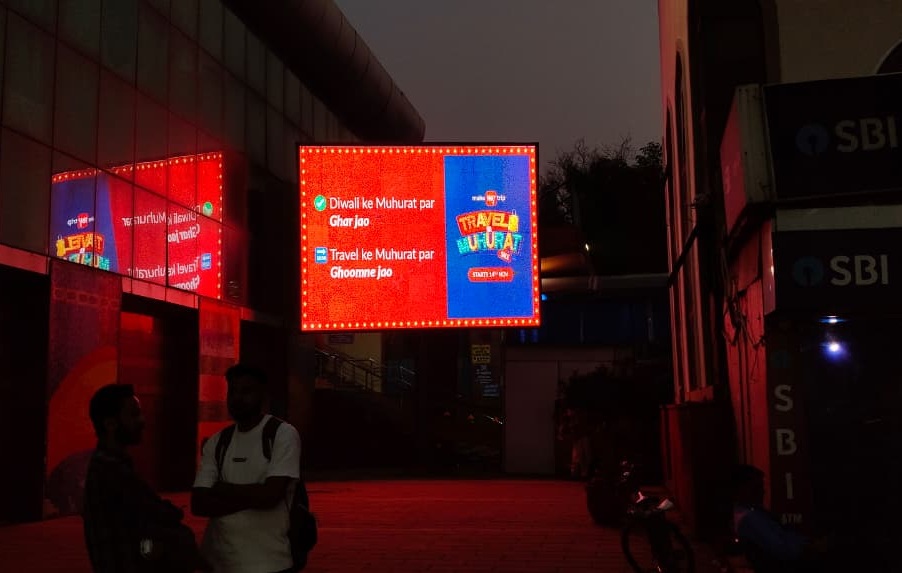
Our LED screen at Hazrat Nizamuddin Railway Station also measures 16.5 feet wide by 13 feet tall and operates 24 hours a day.
Hazrat Nizamuddin is a major terminal in south-east Delhi. It serves a number of important long-distance routes, including services toward southern and western India, as well as prominent trains such as the Rajdhani and Duronto expressways on several corridors. The station’s passenger profile is weighted toward intercity and long-distance travelers rather than daily commuters, which can make it relevant for campaigns targeting people planning multi-day journeys.
The screen at Hazrat Nizamuddin is positioned to reach passengers in transit through the station’s key movement areas.
How the Two Stations Differ for Campaign Planning
Both stations serve long-distance travelers, but their geographic positions and route profiles create different planning opportunities.
| Factor | New Delhi Railway Station | Hazrat Nizamuddin Railway Station |
| Location | Central Delhi; connected to Metro | South-east Delhi; near residential and institutional areas |
| Station character | Multi-directional long-distance hub | Long-distance terminal with routes to southern and western corridors |
| Screen dimensions | 16.5 ft × 13 ft | 16.5 ft × 13 ft |
| Operating hours | 24 hours, 7 days a week | 24 hours, 7 days a week |
| Planning fit | Broad awareness; pan-North-India campaigns | Brands targeting travelers on southern and western India corridors |
These are planning considerations based on our knowledge of the stations and their route profiles. We do not publish specific passenger counts or impression figures for either screen without verified data. Contact us for current information when planning a campaign.
How Passenger Movement Shapes Screen Visibility
Passenger flow at large terminals is not constant. It moves in waves, building before departures and surging after arrivals. Three factors shape how a screen performs within that environment:
- Approach angle. A screen facing oncoming foot traffic gets far more sustained attention than one mounted side-on to a walkway. Passengers approaching a screen head-on have time to register the brand, read a headline and absorb a visual.
- Mounting height and crowd cover. In crowded concourses, groups of passengers can block lower screen areas at eye level. Keeping the brand name and primary message in the upper portion of the creative frame ensures it remains visible even in peak-hour crowds.
- Proximity to dwell behavior. Passengers waiting for train information frequently look upward toward display boards. Screens positioned within that field of view benefit from those repeated upward glances, even without direct intent.
Creative Approaches That Work in Station Environments
From our experience with these screens, these creative approaches tend to work better in station environments:
- Short, silent video (10 to 20 seconds): Edit a TV commercial or social video into a muted version with large on-screen captions. The message must be readable without sound.
- Motion graphics: Simple animations that reveal the product, offer and brand in sequence. Effective for brands without existing video assets.
- Rotating creatives: Two or three versions in rotation, such as a product message and a seasonal offer, reduce repetition fatigue over longer campaigns.
- Bilingual layouts: Hindi and English, combined or alternated, given the traveler mix at Delhi terminals.
- High-contrast design: Bold colors against clean backgrounds outperform dark or low-contrast creatives in station lighting conditions, particularly in semi-open areas with natural light.
How Brands Use Railway Station LED Screens
- Brand awareness: A consistent presence at two Delhi terminals over several weeks or months keeps a brand visible to a steady flow of travelers.
- Product launches: A concentrated burst of screen time during a launch window, combined with digital and print activity, creates simultaneous touchpoints across channels.
- Seasonal promotions: Festive periods such as Diwali, Chhath Puja and Holi bring heavier travel through Delhi terminals. Inventory tends to fill earlier at these times, so plan campaigns several weeks in advance.
- Campaign amplification: Station screens complement city-wide OOH or DOOH campaigns by adding a transit-environment touchpoint alongside roadside, mall and transit media.
Static Hoardings vs Digital LED Screens at Railway Stations
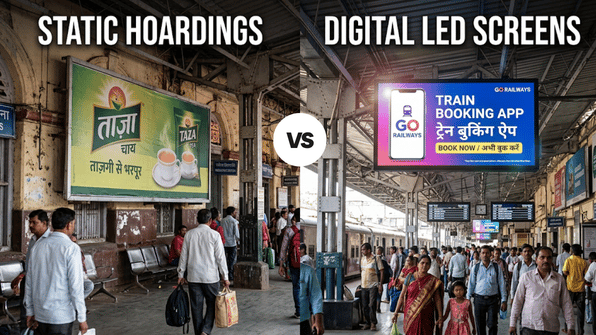
Static hoardings suit long-running, single-message campaigns with fixed budgets. Digital LED screens suit brands that need motion, multiple creatives or the ability to update messaging mid-campaign.
| Factor | Static Hoardings and Panels | Digital LED Screens |
| Presence model | Exclusive; your creative is always visible | Shared loop; your ad appears in scheduled slots |
| Creative format | Single printed image or graphic | Video, animation and multiple rotating creatives |
| Changing creatives | Requires reprinting and physical remounting | Updated digitally without production downtime |
| Production cost | Printing, fabrication and installation | Video or animation production; no printing or mounting cost for updates |
| Attention in busy spaces | Can blend into static surroundings | Motion draws attention in visually crowded environments |
| Low-light and night performance | Depends on lighting type: non-lit, front-lit or backlit | Self-illuminated; consistent visibility at all hours |
| Minimum commitment | Typically monthly | Varies by operator; confirm minimum booking |
| Best suited to | Long-term brand presence; simple, stable messages | Launches, seasonal offers, time-sensitive campaigns and video-led brands |
Many brands use both formats together. Static panels hold continuous brand presence, while LED screens carry time-sensitive messages that need to change
How to Choose the Right LED Screen Advertising Placement
The right LED screen placement faces passenger flow directly, sits near a point where passengers pause or wait, and is not obstructed by crowds, pillars or competing signage.
Screen size is not the primary decision factor. A smaller screen in a well-positioned waiting area will outperform a larger one on a side wall that passengers walk past without looking up.
Use this checklist when comparing screens:
- Does it face oncoming foot traffic? Head-on placements outperform side-on ones.
- Is it near a natural pause point? Train information boards, ticket counters, waiting halls and platform access gates are where passengers slow down.
- Can it be seen over peak-hour crowds? Check mounting height relative to crowding patterns.
- What surrounds it? A screen surrounded by multiple competing panels and signs loses impact. Fewer competing elements mean more attention.
- How many advertisers share the loop? Fewer co-advertisers means your ad plays more frequently per hour.
- What are the operating hours? Confirm whether the screen runs around the clock or only during daytime hours.
- What are the verified screen dimensions? Larger screens are more visible from a distance, but placement still matters more than size.
- Can you review actual photographs of the screen on site? Ask to see installation photos before booking. Do not rely on renderings or floor-plan diagrams alone.
How Much Does Railway Station Advertising Cost in India?
There is no single standard price for railway station advertising in India. Costs vary considerably depending on the station, the format, the placement within the station, the campaign duration, inventory availability and production requirements.
Pricing disclaimer: The figures below are third-party market benchmarks from a single published source. They are not Jagmagads’ rates and do not represent a standard across Indian railway stations. Always request a current, station-specific quotation before finalizing a budget.
For market context, The Media Ant’s published listing for Chennai Central Railway Station (MGR Chennai Central) shows the following indicative offer rates:
- Digital screen: approximately ₹4,50,000 per package per month
- Static panel: approximately ₹30,000 per unit per month
- Hoarding: approximately ₹1,80,000 per unit per month
These are third-party figures for one specific station. Rates at different stations, in different cities and for different formats will vary significantly.
What Factors Influence Railway Advertising Cost?
| Cost Component | What It Covers | Why It Varies |
| Media rental | Advertising space or screen slots | Station importance, placement quality, demand |
| Format | Static panel, backlit display, LED screen | Digital and illuminated formats are priced differently |
| Screen share | Number of advertisers sharing the loop | Exclusive slots cost more than shared loops |
| Campaign duration | Weekly, monthly or longer booking | Longer campaigns may carry different commercial terms |
| Production | Printing, fabrication or video creation | Creative complexity, size and format |
| Installation and maintenance | Mounting, electricity, hardware upkeep | Often charged separately for static media |
| Seasonal demand | Festival periods and peak travel seasons | Higher demand can reduce availability and affect rates |
| Taxes | GST and applicable levies | Added on top of quoted media rates |
Common mistake: Comparing quotes only on media rental. Always request a full cost breakdown covering media, production, installation, taxes and any additional charges before approving a proposal.
7 Creative Railway Station Advertising Ideas for Brands
Selecting the right space is only part of the process. The creative determines whether passengers actually notice, remember and act on your message.
- Design for a three-second read. Use one headline, one key visual and a clearly visible logo. Passengers moving through a concourse rarely read more than one line of body copy.
- Use QR codes only where passengers pause. QR codes work near waiting areas and ticket halls, not on fast-moving walkways. On LED screens, hold the QR frame long enough for passengers to pick up their phones.
- Localize the message. Reference the city, destination or travel moment. “Heading home for Diwali?” works differently at a terminal than a generic national tagline.
- Show the product in motion on digital screens. A short silent demonstration communicates a product benefit faster than descriptive text in a noisy environment.
- Align creatives with travel seasons. Festive travel, summer holidays and back-to-college periods bring different types of passengers to terminals. Creative that acknowledges the journey context tends to feel more relevant.
- Use multiple touchpoints consistently. An entrance placement for awareness and a waiting-area screen for a more detailed message, with the same visual identity, reinforce each other within one passenger journey.
- Connect station advertising to a digital action. A dedicated landing page, a station-specific promo code or a memorable search phrase gives you a way to measure response and extend the campaign online.
How Do You Choose the Right Railway Station for Advertising?
The right railway station for advertising is the one that serves your target audience, not simply the one with the highest total footfall.
Before selecting a station, work through these questions:
- Audience fit: Does this station attract the type of customers your business is trying to reach?
- Geographical scope: Is the objective local awareness, regional expansion or national visibility?
- Route profile: Which destinations does the station serve? This influences the type of traveler passing through.
- Placement quality: Is the advertising inventory positioned where passengers naturally look and pause?
- Budget fit: Can the selected format deliver enough frequency and visibility within your campaign budget?
- Nearby context: Are there hotels, retail districts, offices, colleges or businesses near the station that are relevant to your product?
Example: A hotel group with properties across South India might evaluate terminals in Delhi that serve southbound long-distance routes. A neighborhood service business would typically get more value from a single well-placed panel near a local station exit.
Campaign Planning Checklist
Before confirming any railway station advertising booking, work through this checklist:
Audience and station:
- Have you confirmed that the station serves your target audience?
- Have you checked the route profile to understand which destinations passengers are traveling to?
- Have you visited or reviewed photographs of the actual placement?
Format and placement:
- Have you compared static and digital options against your campaign objective?
- Have you confirmed the screen dimensions, orientation and mounting height?
- Have you assessed whether the placement faces oncoming foot traffic?
- Have you checked what competing signage surrounds the placement?
Commercial terms:
- Have you requested a full cost breakdown including media, production, installation, taxes and additional fees?
- Have you confirmed campaign duration, start date and lead time for creative approval?
- Have you verified the media partner’s authorization or contractual access to the inventory?
Creative and execution:
- Is your creative designed for silent viewing with on-screen text?
- Does the design keep the key message and brand identity in the upper frame?
- Have you prepared at least two creative versions in case of changes mid-campaign?
- Have you agreed on what proof of display you will receive?
What Should Brands Consider Before Booking Railway Station LED Advertising?
Before booking, confirm the screen’s exact location and orientation, how the loop is shared, operating hours, creative specifications, approval requirements and what proof of display you will receive.
For the Jagmagads LED screens at New Delhi Railway Station and Hazrat Nizamuddin Railway Station, the following verified details apply:
- Screen dimensions: 16.5 ft × 13 ft at both locations
- Operating hours: 24 hours a day, 7 days a week
- Format support: Video and image creatives in the operator’s specified resolution
Questions to ask any media partner before booking:
- Can you share actual photographs of the screen in its installed position?
- What is the slot duration, and how many advertisers share the loop?
- What file format, resolution and maximum duration do you require?
- Are there content restrictions or approval steps, and how long do they take?
- What proof of display will we receive — photos, video or play logs?
- What is the nature of your access to this inventory?
- What happens if the screen is offline for maintenance during the campaign?
Practical tip: Prepare at least two creative versions before the campaign launches. A second version lets you refresh the message mid-campaign and respond quickly if one approach is not working.
If you are evaluating LED advertising at New Delhi Railway Station or Hazrat Nizamuddin Railway Station, contact Jagmagads for current availability, slot options and specifications.
How Do You Book Railway Station Advertising in India?
Booking railway station advertising involves five steps: defining your objective, selecting stations and formats, engaging an authorized media partner, obtaining creative approval, and monitoring campaign execution.
Railway station advertising inventory is managed through authorized arrangements with Indian Railways, concessionaires or licensed media operators. Train advertising regulations require brands to work with licensed vendors to ensure compliance.
Step 1: Define Your Campaign Objective
Decide whether the priority is building brand awareness, generating enquiries, driving store visits or supporting a product launch. This shapes your choice of station, format, creative and campaign duration.
Step 2: Select Stations and Formats
Compare stations on audience relevance, placement quality, inventory availability and budget. Decide between static, digital or a combination, based on your creative assets and campaign goals.
Step 3: Engage a Railway Station Advertising Agency
An experienced railway station advertising agency can identify available inventory, confirm commercial terms and coordinate execution. Before committing, verify that the agency holds authorized access to the inventory it is offering.
Step 4: Prepare and Approve Creatives
Supply artwork or video files in the required specifications. Allow time for review by the relevant authority, concessionaire or operator. Creative approval timelines vary, so build this into your campaign schedule.
Step 5: Launch and Monitor
Request installation photographs or on-screen video confirmation of your ad running. For LED campaigns, ask for periodic proof of display throughout the booking period. Confirm that placements, dates and loop positions match what was agreed.
Allow several weeks between initial enquiry and campaign launch, particularly during festival seasons when inventory demand is higher.
How Do You Measure Railway Advertising Campaign Performance?
Railway station advertising performance can be tracked using QR codes, promotional codes, brand search monitoring, customer surveys and proof-of-display reports.
No single method provides complete attribution, so using several together gives a more reliable picture.
- QR code tracking: Assign a unique QR code to each station or screen. Compare scan volumes across placements to assess relative engagement.
- Promotional codes: Use station-specific discount or referral codes to identify enquiries and purchases that can be traced to a particular location.
- Brand search monitoring: Track changes in branded search volume in the campaign region during and after the flight. Account for other marketing activities running at the same time.
- Customer surveys: Ask new customers where they first became aware of your brand. Include railway advertising as an option.
- Campaign delivery verification: Compare contracted placements, slot schedules and campaign dates against installation photographs, on-screen video and play logs.
- Creative rotation comparison: On LED screens, run two creative versions in alternate slots over a period of weeks and compare response metrics such as QR scans or enquiry volumes.
These methods provide useful directional data. They cannot always establish a direct causal link between a specific ad and a specific purchase, but they can inform decisions about station selection, creative approach and campaign duration.
Which Businesses Can Benefit From Railway Station Advertising?
Railway station advertising can deliver results for a wide range of businesses, from national consumer brands to local service providers, provided the station, placement and message are well matched to the audience.
| Industry | Typical Campaign Message | Formats to Consider |
| Education and coaching institutes | Admissions, exam preparation, course enrolments | LED screens near waiting areas; backlit panels |
| Hotels and hospitality | Accommodation, packages, booking offers | Entry and exit placements; LED screens |
| Travel and cab services | Transfers, tours, bookings | Entry and exit gate ads; LED screens |
| Retail and FMCG | New product launches, festive offers | LED screens; platform panels |
| Banking and financial services | Digital banking, travel insurance, credit products | Static panels; full station branding |
| Healthcare and diagnostics | Hospital services, health screenings | Panels near exits; LED screens |
| Consumer apps and tech | App downloads, sign-up promotions | LED screens with QR codes |
| Real estate | Project launches, site visits | LED screens; hoardings near major terminals |
Industry category matters less than audience fit. A clearly targeted campaign at the right station will outperform a larger budget applied without a defined audience in mind.
Frequently Asked Questions About Railway Station Advertising
1. How much does railway station advertising cost in India?
Railway station advertising costs depend on the station, advertising format, placement, campaign duration and production requirements. For example, The Media Ant’s published listing for Chennai Central Railway Station shows digital screens at approximately ₹4,50,000 per package per month and static panels at approximately ₹20,000 per unit per month. These are third-party reference prices, not standard rates. Contact an advertising agency for a current, station-specific quotation.
2. What are the different types of railway station advertising formats?
Railway station advertising includes static hoardings, backlit panels, digital LED screens, entry and exit gate branding, pillar wraps, wall branding, train wraps and full station branding. Each format offers different visibility opportunities depending on campaign objectives, audience reach and budget.
3. Is LED screen advertising effective at railway stations?
Yes, LED screen advertising can be highly effective at railway stations because dynamic visuals and video content help attract passenger attention. Advertisers can update creatives, promote multiple offers and run time-sensitive campaigns without replacing printed materials. Screen placement, advertisement frequency and creative quality play an important role in campaign effectiveness.
4. How long should a railway station advertising campaign run?
Campaign duration depends on your marketing objectives. Short-term campaigns of two to four weeks can support product launches and promotional offers, while brand awareness campaigns may benefit from one to three months of visibility. The ideal duration also depends on passenger traffic, station selection and advertising format.
5. How can I book railway station advertising in India?
To book railway station advertising, select your target station and advertising format. Contact an authorised media operator or an advertising agency with verified access to the required inventory. Confirm pricing, screen or panel specifications, campaign duration and creative approval requirements before booking.
6. Can I advertise at New Delhi Railway Station or Hazrat Nizamuddin Railway Station?
Yes, Jagmag Advertising offers LED screen advertising opportunities at New Delhi Railway Station and Hazrat Nizamuddin Railway Station. The available screens measure 16.5 ft × 13 ft and operate 24 hours a day. Contact Jagmag Advertising to enquire about current availability, advertising slots and creative specifications.