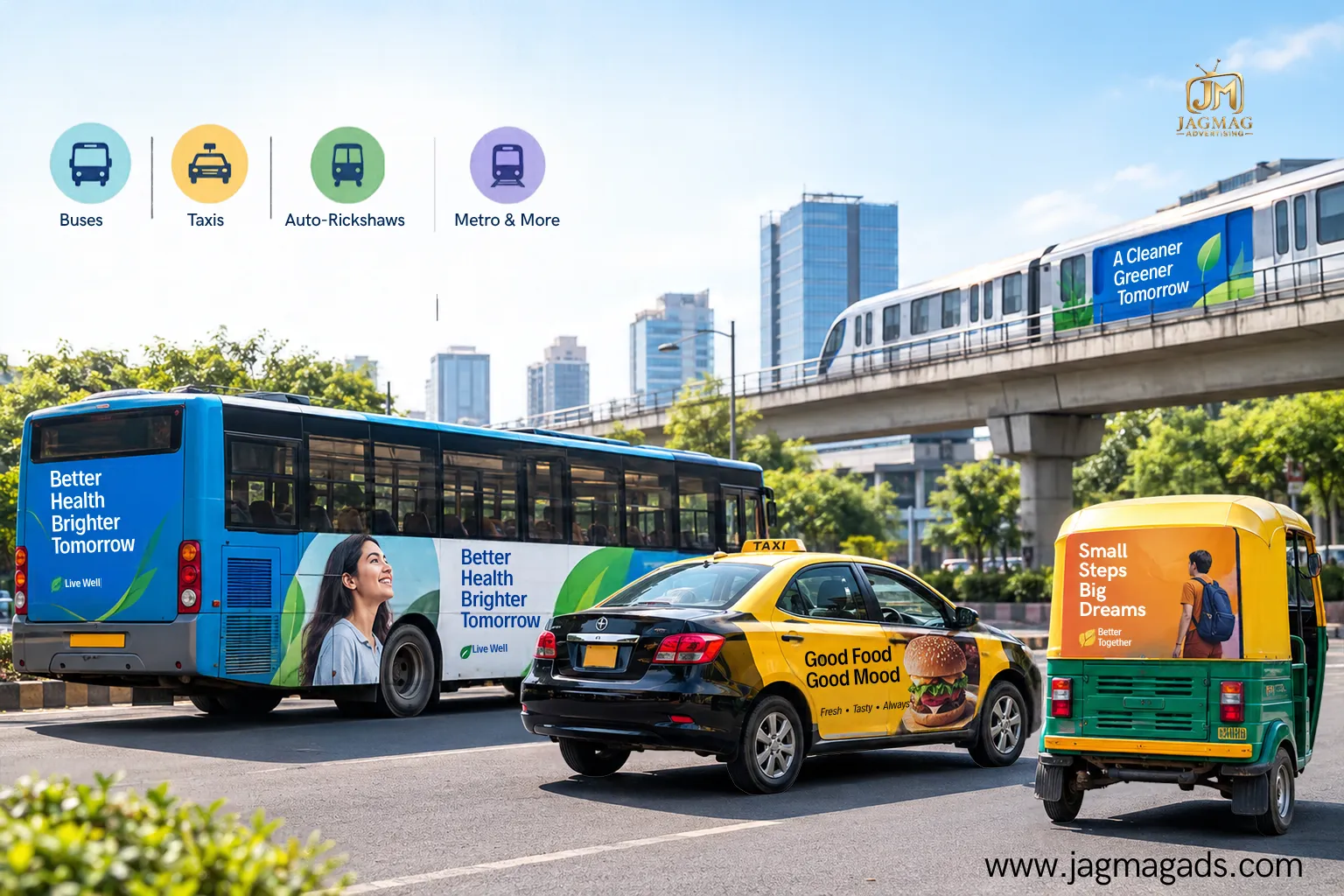
The correct term is transit advertising, a category of out-of-home (OOH) advertising that uses vehicles such as buses and taxis to display brand messages. Common formats include full bus wraps, taxi door panels, exterior vehicle branding and advertisements inside public transport vehicles.
What is transit advertising, and how does it fit into OOH?
Out-of-home advertising reaches people outside their homes through physical advertising placements in public spaces. Examples include billboards, roadside displays, transport environments and branded vehicles.
Transit advertising is a specialised part of OOH marketing. Its defining feature is that advertisements travel with vehicles or appear within transport systems.
Unlike a fixed billboard, a bus or taxi may pass through multiple neighbourhoods, shopping districts and commercial corridors during its operating day. This creates opportunities for exposure in different locations, provided the vehicle’s operating area matches the campaign’s target geography.
Neither transit advertising nor billboard advertising is automatically the better choice. The right format depends on the campaign objective, audience location, budget and available advertising inventory.
For an overview of other available formats, explore Jagmagads outdoor advertising and OOH media solutions.
Which advertising formats fall under transit advertising?
Transit advertising includes several vehicle-based formats. Each offers different creative possibilities and geographic coverage.
Bus advertising and full bus wraps
Bus advertising presents promotional content either on the interior or exterior surfaces of a bus.
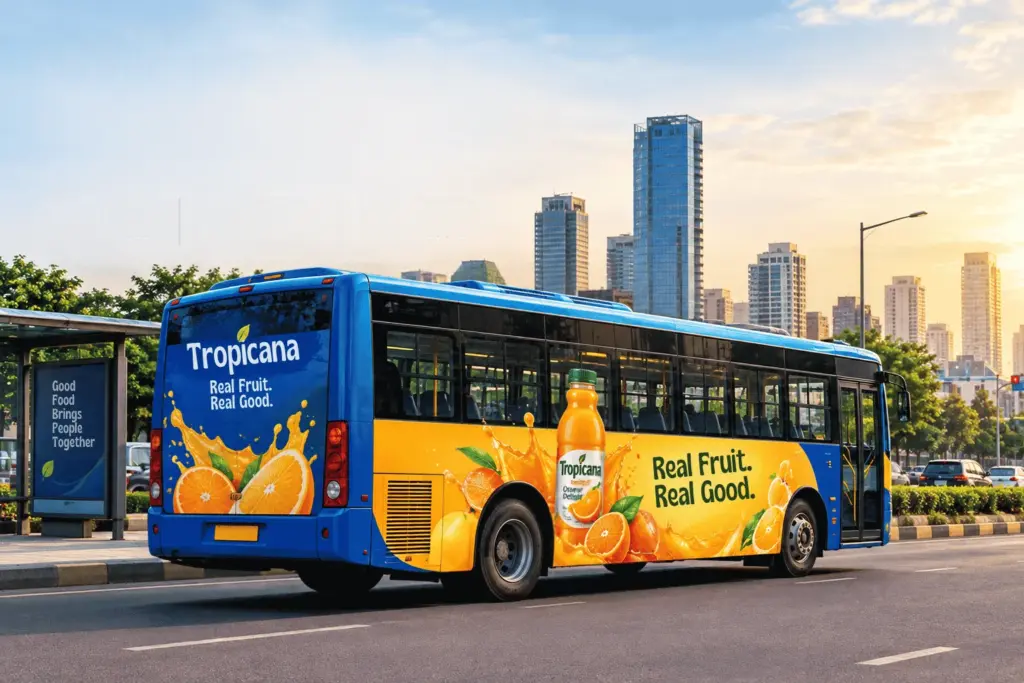
Typical formats include:
- Full bus wraps: Extensive branding covering significant areas of the vehicle’s body.
- Side panels: Ads displayed along the bus sides, offering space for a larger creative.
- Rear panels: Branding on the back of the bus, visible to people travelling behind it.
- Interior advertising: Panels or other approved placements inside the vehicle, seen by passengers.
Full wraps offer substantial creative space but require artwork adapted around windows, doors and other vehicle features. Smaller panels may suit campaigns with simpler messages or more limited production budgets.
Taxi and taxicab advertising
Taxi advertising uses branding on taxis and other cab vehicles. Depending on the available inventory, placements may include door panels, partial wraps, full exterior wraps or approved roof-mounted displays.
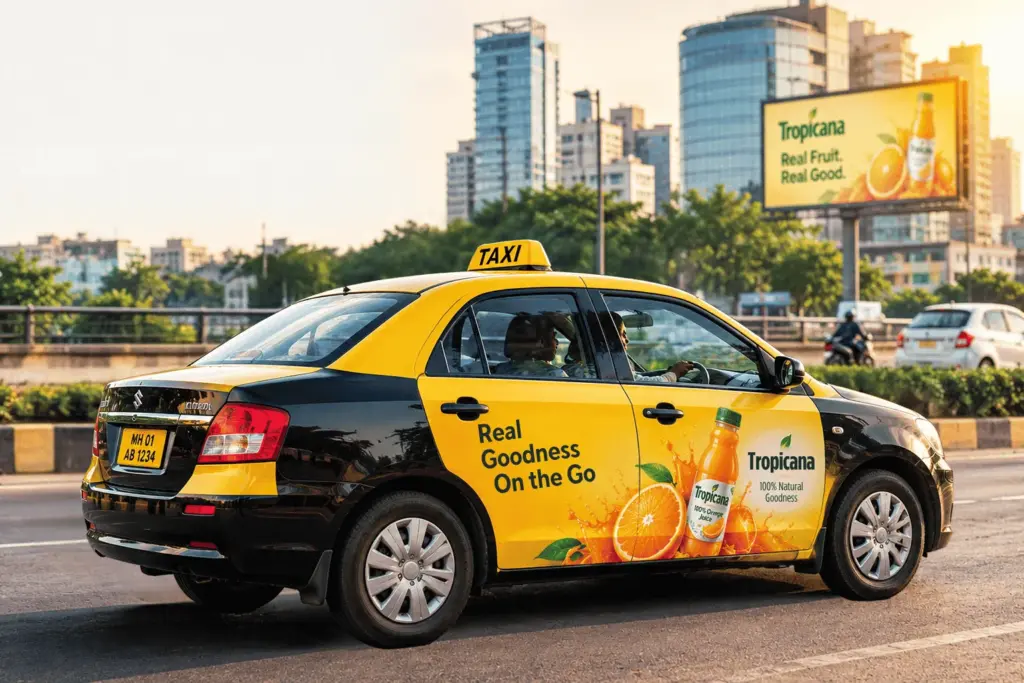
Taxi campaigns can be beneficial for businesses that want to promote their brand in specific urban areas. However, the travel patterns of a taxi fleet may not align with those of a public bus route. Therefore, marketers should verify the actual routes and expected areas of operation for the taxis rather than assuming they provide uniform coverage throughout the entire city. Auto-rickshaw, van and other vehicle advertising
Advertising on auto-rickshaws is effective for local campaigns, particularly in areas where these vehicles frequently operate, such as markets and residential neighborhoods. Similarly, mobile van branding can enhance promotional roadshows or campaigns that require vehicles to visit targeted locations. Metro train branding, in-vehicle advertisements and certain fleet-vehicle campaigns can also fall within transit media, depending on the placement and how the media is sold.
There is a useful distinction here: advertising on a moving vehicle is not the same as advertising at a transport location. Metro station panels, railway station branding and airport displays are OOH placements associated with transit environments, but they are stationary media rather than vehicle advertising.
Jagmag offers several OOH solutions across these categories, including transit advertising, metro advertising, railway station branding and auto-rickshaw advertising. The suitable mix depends on the campaign rather than the number of formats an agency can list.
For a related option, see Auto-Rickshaw Advertising.
How does a bus advertising campaign work?
A campaign should begin with a geographic and commercial objective, not a decision to wrap as many buses as possible.
Choose routes before choosing the number of buses.
Start by pinpointing where the intended audience resides, works, shops, or travels. Then assess the bus routes in connection with those areas.
A company advertising a new store should look into the routes that cover the store’s target zone. A brand aiming for wider recognition might opt for routes that link multiple relevant neighborhoods.
Ask the media provider for the proposed routes, vehicle details and any available route schedules. Confirm whether the selected vehicles can be reserved for the campaign and whether route changes are possible during the booking period.
Match the format to the message
The creative must work at the distance from which people are likely to see it.
A bus side panel has more room for a visual and supporting message. A rear panel may call for a simpler layout. Interior advertising can accommodate information intended for passengers who have more time to look at it.
Keep the main message short, make the brand recognisable and use a clear call to action where appropriate. A complicated offer or a long URL is unlikely to work well for someone who sees the bus briefly in traffic.
Set the campaign duration and audience plan
Duration impacts both budget and opportunities for repeated exposure. The appropriate length depends on the campaign objective, inventory terms, creative production requirements, and available funds. Audience targeting in transit advertising is primarily geographic and contextual. Marketers can select routes, vehicle types and operating areas that are relevant to their audience, but should not treat route selection as proof of an individual’s demographics or purchasing behaviour.
What affects bus advertising cost in India?
There is no single bus advertising cost that applies across every Indian city, fleet and format. The price should be based on the actual inventory being offered.
The following factors deserve attention when requesting a quotation.
| Pricing factor | What to check |
| City and route | The location, route demand and availability of suitable vehicles |
| Vehicle type | City bus, intercity coach or another vehicle category |
| Advertising format | Full wrap, side panel, rear panel or interior placement |
| Campaign duration | Booking period, renewal terms and any minimum commitment |
| Production | Artwork adaptation, printing, material and finishing |
| Installation | Application, vehicle scheduling, removal and reinstatement where applicable |
| Permissions | Applicable approvals, charges and responsibility for obtaining them |
| Inventory availability | Number of vehicles available, dates, routes and competing bookings |
A full vehicle wrap usually requires more materials and installation effort than a smaller panel. However, the total cost also depends on the specific vehicle and the details outlined in the quotation. It is essential to compare the actual deliverables rather than assuming that one option consistently offers better value.
Please provide a comprehensive quote that distinguishes between media rental and production, as well as installation when relevant. Kindly verify the tax implications, payment conditions, cancellation terms, and protocols for replacing a vehicle if it becomes unavailable. Avoid making comparisons based solely on the total quoted amount. Instead, evaluate the proposals based on the quantity of vehicles, format, route coverage, duration of the campaign, and reporting obligations as well.
How do you choose the best bus advertising agency?
The best bus advertising agency for a campaign is one that can supply the right inventory, document the agreed scope and provide credible evidence of execution. A large portfolio or a low quotation alone is not enough.
Use the following checks before making a decision.
1. Verify the available inventory.
Ask for information regarding the exact vehicles, routes, and advertising formats that are offered for the dates of your campaign. Seek comprehensive details rather than merely accepting a vague promise of citywide coverage.
2. Check geographic coverage.
An agency may serve several cities but have different inventory, partners or operating capabilities in each one. Confirm the locations relevant to your campaign.
3. Demand a transparent quotation.
The proposal should explain media charges, production, installation, permissions and reporting. Ask about additional costs before approving the booking.
4. Clarify permissions and responsibility.
Establish who obtains the necessary transport authority, fleet-owner or other applicable approvals. Confirm that the agreed creative and placement are permitted before installation begins.
5. Inspect production standards.
Ask how artwork is adapted to each vehicle, what materials will be used and how installation quality will be checked. Poorly positioned or damaged branding can undermine the campaign.
6. Agree on monitoring and reporting.
Inquire about the proof that will be provided, such as dated campaign photographs, vehicle identification, route records when available, and condition checks. Understand what evidence can and cannot establish.
A bus advertising company should also explain how it will handle damaged creative, unavailable vehicles or changes to the agreed schedule.
Jagmag serves brands across India with OOH advertising solutions. If you are considering a campaign, start by sharing the target city, intended audience, preferred format, campaign period and budget. These details make it easier to assess suitable options without assuming that every format is available everywhere.
What are the advantages and limitations of bus advertising?
Bus advertising can provide moving brand visibility across several locations through a single campaign. It can be particularly useful for local brand awareness, store openings, product launches and businesses that want repeated exposure along selected routes.
There are trade-offs.
- Route dependence: A bus effectively covers geographic areas only if its route meets the needs of its intended audience.
- Limited reading time: Exterior advertisements must communicate quickly, especially in moving traffic.
- Variable visibility: Congestion, vehicle orientation, weather, obstructions and the condition of the creative can affect how clearly an advertisement is seen.
- Measurement limits: Photographs can confirm that branding was installed, but do not by themselves establish how many people saw it or whether it generated sales.
- Operational changes: The availability of vehicles and route schedules can change, so it’s important to pay attention to monitoring and replacement terms.
Bus advertising is therefore best treated as a planned OOH channel, not as a substitute for every other marketing activity. A retailer might combine it with Billboard Advertising to maintain visibility around a fixed location, or use Railway Station Branding to reach people at a particular transport hub.
The mix should follow the campaign’s geographic priorities and objectives.
What should you do before booking a bus advertising campaign?
Prepare a brief with the target city, audience locations, campaign dates, preferred vehicle format, budget and the result you want to measure. Ask agencies to respond against the same requirements, with itemised pricing, confirmed inventory and a clear monitoring plan.
Then compare the proposals on what will actually be delivered, not just on headline reach claims.
For Jagmag, the sensible next step is to discuss your campaign requirements and evaluate the available OOH formats against them. A well-matched route, readable creative and verifiable execution are a stronger starting point than simply booking the largest possible wrap.
Plan Your Transit Advertising Campaign with Jagmag
If you’re considering bus advertising, taxi branding or other transit media, Jagmag Advertising can be a starting point for discussing suitable OOH options.
Share your target locations, campaign dates, preferred format and budget so the team can assess the available options against your requirements. Confirm specific vehicle availability, routes, pricing and execution commitments before booking.
Frequently Asked Questions About Transit Advertising
1. Which term refers to an out-of-home medium that includes bus and taxicab advertising?
Transit advertising is the term commonly used for advertising on buses, taxis and other transport vehicles. It is a category of out-of-home advertising.
2. What are the main types of transit advertising?
Common formats include full bus wraps, bus side and rear panels, taxi branding, auto-rickshaw advertising, mobile van branding and advertisements inside vehicles. Availability depends on the market and media provider.
3. How much does bus advertising cost in India?
Costs depend on the city, routes, vehicle type, advertising format, campaign duration, production and installation requirements. Request an itemised quotation for accurate pricing.
4. What is the difference between transit advertising and billboard advertising?
Transit advertising uses vehicles or transport-related media, while billboards are generally fixed outdoor displays. Both can support brand awareness and local marketing.
5. How can businesses measure transit advertising performance?
Businesses can verify installation through dated photographs and vehicle details. Audience exposure estimates, customer responses and sales attribution require additional evidence and measurement methods.